The idea of Green chemistry challenge is the development of chemical products and processes that decrease or eliminate the use of hazardous compounds. Green chemistry pertains to a chemical product’s whole life cycle, including its design, production, usage, and disposal.
The Development of Green Chemistry
The concept of green chemistry emerged from the business and regulatory sectors as an extension of pollution prevention efforts. This movement was primarily driven by the unforeseen consequences of various advancements in industrial and medical fields, which, while beneficial, ultimately inflicted harm on both the environment and human health.
Triggering Awareness
By the mid-20th century, the detrimental impacts of some of these technological advancements became evident. Key indicators were the pollution of waterways and the deterioration of forests due to acid rain. Additionally, there was growing concern over the depletion of the ozone layer and the health risks posed by common chemicals, some of which were potentially carcinogenic.
Regulatory Response
In response to mounting environmental damage, governments globally began to clamp down on industrial waste and emissions. A pivotal moment was the establishment of regulatory bodies like the Environmental Protection Agency (EPA) in the United States in 1970. These organizations were tasked with crafting and enforcing regulations designed to safeguard both human and environmental health.
Thus, the green chemistry movement was born—a field focused on designing products and processes that minimize the generation of hazardous substances, aligning economic performance with environmental stewardship. Through this, green chemistry aims to create more sustainable practices within industries worldwide.
Environmental chemistry:
At the molecular level, it prevents contamination. Is a viewpoint that applies to all fields of chemistry, rather than just one. Applying novel scientific answers to real-world environmental issues
Source reduction occurs as a result of the prevention of pollutant creation. Reduces the detrimental effects of chemical goods and processes on human health and the environment. Reduces, and often eliminates, the risk associated with current products and processes.
You may also like to read : Step by step instructions to Use Green Products for Spring Cleaning Services
Creates chemical goods and processes with the goal of lowering their inherent risks in the generation of hazardous substances. Many toxic chemicals used in labs have less-toxic or non-toxic alternatives available.
For instance, ethidium bromide, a common lab chemical known for its toxicity, can be replaced with safer options. These alternatives not only mitigate health risks but also contribute to a more sustainable lab environment.
By focusing on substituting harmful substances with these safer alternatives, laboratories can significantly reduce their ecological footprint and enhance safety protocols.
Through innovation and diligent research, the chemical industry continues to develop solutions that align with both safety and environmental goals.
How green chemistry differ from pollution cleanup?
Green chemistry eliminates pollution at its source by reducing or eliminating the risks associated with chemical feedstocks, reagents, solvents, and products from the chemical industry in green chemistry and engineering to design chemical products that are cost-effective. This proactive approach extends beyond traditional environmental regulations by encouraging chemists and engineers to rethink and redesign their processes and products to prevent pollution and waste from the outset.
Innovative Design
Unlike conventional methods that focus solely on compliance and remediation, green chemistry challenges professionals to design chemicals, chemical processes, and commercial products in ways that avoid the creation of toxics and waste. This forward-thinking strategy is about innovation and creating a sustainable future for the industry.
Prevention vs. Remediation
This differs from pollution cleanup (also known as remediation), which entails treating waste streams (end-of-the-pipe treatment) or cleaning up environmental spills and other discharges. Remediation removes harmful compounds from the environment; green chemistry, on the other hand, stops hazardous materials from entering the environment in the first place. By doing so, it creates a new reality for chemistry and engineering, shifting the focus from managing pollution to preventing it.
A green chemistry technique is one that decreases or eliminates the use of harmful chemicals in the cleanup of environmental pollution, thereby fostering a cleaner, safer environment starting from the design phase. This comprehensive approach not only meets but exceeds regulatory expectations, setting a new standard for sustainability in the chemical industry.
By the middle of the 20th century, the dark side of advancements in chemistry began to reveal itself. Industrial progress led to severe environmental issues. Waterways around the globe suffered from high levels of pollution, threatening aquatic life and human health. The increase in toxic emissions contributed to acid rain, which wreaked havoc on forests and ecosystems.
Additionally, noticeable damage was detected in the earth’s ozone layer, leading to increased UV exposure. This was partly due to certain chemical compounds in wide circulation. Moreover, several of these substances were linked to negative health impacts, such as cancer and other serious illnesses, both in humans and wildlife. The environmental cost of these chemical advancements was becoming harder to overlook.
The 12 Principles of Green Chemistry: A Pathway to Safer Alternatives in the Lab
In every laboratory, hazardous chemicals are often seen as a necessary evil. However, they don’t always have to be part of the equation. By applying the 12 Principles of Green Chemistry, we can transition to safer, more sustainable practices, finding alternatives that protect both human health and the environment.
The 12 Principles of Green Chemistry
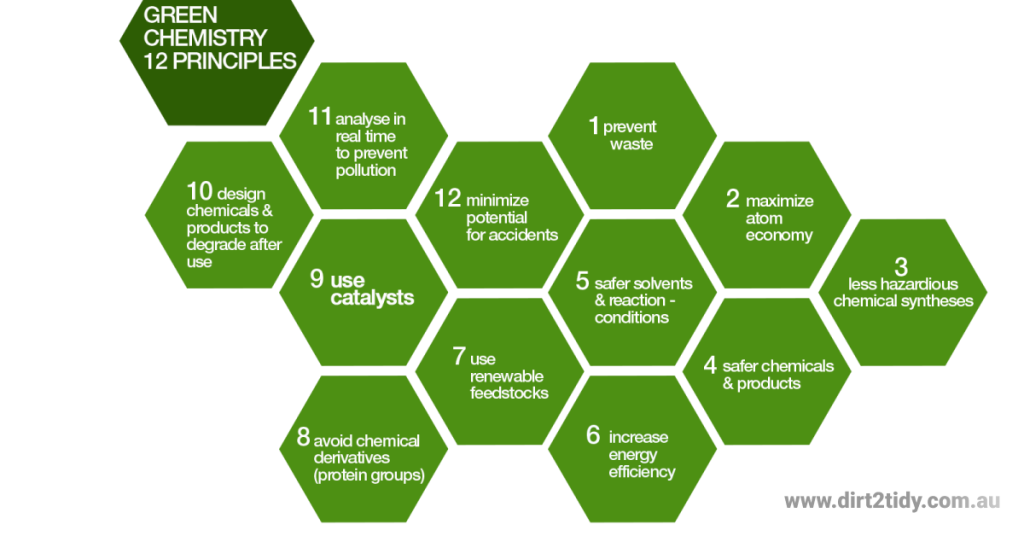
These concepts reflect the scope of the green chemistry concept:
- Reduce Waste: Create waste-free chemical syntheses. There should be no trash to process or clean up.
- Increase the Atom Economy: Design syntheses such that the final product includes the greatest proportion of the starting components. A few or no atoms are wasted.
- Create Less Hazardous Chemical Syntheses: Develop processes that employ and create compounds that are not damaging to humans or the environment.
- Create Safer Chemicals and Goods: Formulate chemical products that are totally effective while containing little or no harm.
- Employ Safer Solvents and Reaction Conditions: Avoid the use of solvents, separation agents, and other auxiliary chemicals. If these substances must be used, opt for safer alternatives.
- Improve Energy Efficiency: When feasible, conduct chemical processes at ambient temperature and pressure.
- Use Renewable Feedstocks: Opt for renewable rather than depletable beginning materials (also known as feedstocks). Renewable feedstocks are frequently agricultural products or wastes from other processes; depletable feedstocks are often fossil fuels (petroleum, natural gas, or coal) or mining operations.
- Avoid Chemical Derivatives: If feasible, avoid utilizing blocking or protective groups or other temporary alterations. Derivatives need more reagents and produce waste.
- Use Catalysts Rather Than Stoichiometric Reagents: Employ catalytic processes to reduce waste. Catalysts are effective in small quantities and can perform a single reaction several times. They are preferred over stoichiometric reagents, which are used in excess and only perform one reaction.
- Create Chemicals and Goods That Degrade After Use: Design chemical products that degrade to harmless compounds after use, preventing them from accumulating in the environment.
- Real-time Analysis to Reduce Pollution: Include in-process, real-time monitoring, and control during syntheses to limit or eliminate byproduct generation.
- Reduce the Possibility of Accidents: Design chemicals and their physical forms (solid, liquid, or gas) to minimize the risk of chemical mishaps such as explosions, fires, and environmental discharges.
Green Chemistry: More Than Just a Set of Principles
Green chemistry is not merely about reducing the hazards of existing chemicals, but rather about reimagining how we approach chemical design and production. By adhering to these principles, labs can systematically replace harmful materials with safer ones, ensuring that sustainability and safety are at the forefront of scientific innovation. This proactive approach not only minimizes risks but also fosters a culture of responsibility and innovation in scientific research.
What are some of the proposed metrics for evaluating greener processes and products?
Several metrics have emerged to assess the sustainability of processes and products. These include:
- Mass Efficiency: Assessing the amount of raw material utilized versus the final product yield to maximize resource use.
- Energy Consumption: Measuring the energy required in the production process to encourage more sustainable energy practices.
- Reduction of Hazardous Substances: Quantifying the decrease or elimination of toxic materials involved in manufacturing and products.
- Life Cycle Environmental Impact: Analyzing the overall environmental footprint of a product from creation to disposal, promoting improvements across its entire lifecycle.
These metrics provide a framework for companies to implement and track sustainable practices effectively, encouraging ongoing progress toward environmental responsibility.
How to Quantify Green Chemistry Through Metrics
Quantifying green chemistry involves measuring various aspects to ensure that chemical processes and products are environmentally friendly. Though there’s no single, universal metric, several measurement approaches have been recognized to gauge just how sustainable these processes and products are.
- Mass Efficiency: One way to measure green chemistry is through mass efficiency. This involves evaluating how much raw material ends up in the final product, minimizing waste in the process.
- Energy Consumption: Comparing the energy required to run chemical processes can also serve as a metric. The goal is to develop processes that use less energy, thereby reducing the carbon footprint.
- Reduction of Hazardous Substances: Another crucial metric is the reduction or complete elimination of hazardous chemicals involved in the process. This not only minimizes environmental harm but also increases safety for those handling these substances.
- Life Cycle Environmental Impact: Assessing the entire life cycle of a product—from raw material extraction to disposal—provides a comprehensive view of its environmental impact. This includes examining potential pollution, resource depletion, and overall ecological damage.
By employing these metrics, businesses and researchers can better understand and refine their processes to support a more sustainable future.
Is Green Chemistry Considered a Political Strategy or a Public Relations Effort?
The Essence of Green Chemistry:
Green chemistry stands apart from politics and public relations. It emerges from the realm of science, focused on creating sustainable and efficient chemical processes that minimize waste and environmental impact. This field molds the future of manufacturing by emphasizing safety and sustainability without being constrained by political agendas or PR tactics.
Rooted in Innovation, Not Politics:
Unlike political strategies, green chemistry is driven by scientific innovation. It’s about finding new pathways to produce chemicals that reduce harm to the planet. The objective is clear: to improve processes and products while safeguarding our environment. This scientific pursuit transcends political boundaries, aiming for solutions beneficial to all.
Beyond Public Relations:
Green chemistry does more than promote a positive image. While it may enhance a company’s reputation for environmental responsibility, its core mission is effectiveness and sustainability. This focus fosters genuine change in industrial practices, rather than serving as a superficial PR effort.
In summary, green chemistry is guided by scientific principles and ecological responsibility, distinguishing itself from political or public relations maneuvers.
Who Benefits from Green Chemistry?
Green chemistry isn’t just for chemists—it’s for everyone who uses chemicals. From professionals in laboratories to everyday consumers, adopting green chemistry practices can significantly reduce exposure to harmful substances.
Green Chemistry’s Advantages for Human Health
- Cleaner Air: Less dangerous chemicals are released into the atmosphere, resulting in less lung damage.
- Cleaner Water: Reduced chemical waste means cleaner drinking and recreational water.
- Increased Safety for Chemical Workers: With reduced use of dangerous chemicals, there’s less need for personal protective equipment and a lower risk of accidents, such as fires or explosions.
You may also like to read: Eco is the Way to Go!
- Safer Consumer Items: Products like medications and insecticides are manufactured with less waste, and some are substituted for safer alternatives.
- Food Safety: By removing persistent harmful substances from the food chain and using safer pesticides, food becomes safer. These pesticides target only specific pests and break down quickly after use.
- Less Exposure to Harmful Compounds: Reducing substances like endocrine disruptors benefits everyone, from the scientist in the lab to the consumer at home.
By integrating green chemistry into daily practices, a wide array of individuals and communities stand to gain—from enhancing personal health to protecting the environment.

Governments across the globe took decisive action in response to the harmful impacts of certain chemicals by implementing strict regulations. In an effort to safeguard both human and environmental health, many nations created agencies dedicated to monitoring and managing industrial pollution.
For instance, in 1970, the United States established a federal authority specifically for this purpose. This agency was tasked with formulating policies and standards to control the generation and disposal of hazardous industrial byproducts. By setting and enforcing these regulations, governments aimed to curtail environmental degradation and protect public health.
These regulatory measures involved not only monitoring waste emissions but also ensuring that industries adhered to guidelines that mitigated pollution. This proactive approach marked a significant shift towards accountability and sustainability in industrial operations.
How Sharing Chemicals and Contributing to a Chemical Inventory Can Minimize Chemical Usage
Sharing chemicals and contributing to a chemical inventory play crucial roles in reducing the overall use of chemicals. Here’s how these practices can lead to more efficient and environmentally friendly outcomes:
- Prevention of Waste
By sharing chemicals, laboratories or institutions can prevent the excessive purchase of materials. This exchange ensures that chemicals are used up before they expire, rather than being discarded as waste. - Cost Savings
Sharing leads to lower acquisition costs. Labs or organizations can save money by borrowing or exchanging chemicals rather than purchasing new supplies, which helps allocate resources more effectively. - Encouragement of Sustainable Practices
A communal chemical inventory encourages participants to be mindful of their consumption. By tracking the quantity and types of chemicals in use, organizations can identify opportunities to substitute or reduce certain substances, promoting sustainable practices. - Centralized Management
An organized chemical inventory allows for centralized tracking and monitoring. This management helps prevent over-ordering and ensures that all chemicals are efficiently used, aligning with regulatory compliance and reducing chemical footprint. - Fostering Collaboration
Sharing and contributing foster a collaborative environment between departments or organizations. This teamwork can lead to discovering alternative solutions or innovative methods that further reduce chemical use. - Improvement in Storage and Safety
An up-to-date inventory simplifies chemical storage and enhances safety protocols. By maintaining appropriate chemical levels, facilities can better manage risks associated with storage of hazardous materials.
By embracing these strategies, organizations not only contribute to environmental conservation but also cultivate a culture of efficiency and responsibility.
Environment:
Many chemicals wind up in the environment as a result of purposeful releases during usage (e.g., insecticides), inadvertent releases (such as emissions during manufacture), or disposal. Green chemicals decompose into harmless byproducts or are collected for future use.
Toxic substances in the environment cause less harm to plants and animals.
Reduced risk of global warming, ozone depletion, and smog production
Ecosystems are subjected to less chemical perturbation.
Less reliance on landfills, particularly hazardous waste landfills.
Economy and commerce:
Higher yields for chemical processes require less feedstock to produce the same quantity of output.
Fewer synthetic stages, which frequently allows for speedier product manufacture, increased plant capacity, and energy and water savings.
Waste reduction, the elimination of expensive cleanup, hazardous waste disposal, and end-of-pipe treatments
Allow for the substitution of a waste product for a bought feedstock.
improved performance, so that fewer products are required to fulfill the same job
Reduced usage of petroleum products, which slows depletion while reducing dangers and price swings.
Increased throughput results in a smaller manufacturing facility size or footprint.
Earning and displaying a safer-product label increased customer sales (e.g., Safer Choice labeling).
Chemical firms’ and their clients’ competitiveness has improved.