
Difference Between Vacant Clean and Vacant Dirty Why Room Status Matters in Hotels So What Is Involved in It?
Common Room Status Codes in Hospitality The Life Cycle of a Guest Room Room Status Reconciliation Why Vacant Clean vs Vacant Dirty Matters Training Staff on Room Status Terminology Several times throughout the guest’s stay, the cleaning status of the guest room changes.
The numerous words specified are typical of the hospitality industry’s room status language, and not every guest will experience the same room status during their stay. Changes in this status should be reported to the front office as soon as possible in order to optimize room sales and income.
For non-automated or semi-automated hotels, maintaining a timely housekeeping service status necessitates careful coordination and collaboration between the front desk, the housekeeping staff, and in some cases, professional cleaning services brought in to ensure rooms meet the highest standards.
To understand why these terms matter, and how they differ, let’s take a closer look at the terminology, the processes involved, and the bigger picture of room status management in hotels.
For guests, a room is simply “ready” or “not ready.” But behind the scenes, hotels use a complex system of terminology to ensure clarity between teams. Room status isn’t only about cleanliness it directly affects: Revenue management – A room can’t be sold or reassigned until it’s marked appropriately in the system.
Operational efficiency – Housekeeping and the front desk rely on accurate room status to prevent double assignments or delays. Guest experience – A clean, properly prepared room ensures a smooth check-in and a positive first impression. When communication breaks down, issues arise.
Imagine a guest arriving to a hotel room that’s technically “vacant,” but not yet serviced – that’s the difference between Vacant Clean and Vacant Dirty. Understanding the Difference Between “Empty” and “Vacant” Although “empty” and “vacant” are sometimes used interchangeably in everyday speech, they carry distinct meanings especially within the world of hotels and housekeeping.
Empty : This word simply means that there is nothing inside no objects, no people, just a total absence of contents. For example, an empty suitcase has nothing in it, and an empty glass holds no liquid. Vacant : In the context of a hotel room, “vacant” refers specifically to the absence of occupants.
A room is considered vacant if no guest is currently staying in it, regardless of whether there’s furniture, décor, or even someone from the housekeeping team passing through. Vacant rooms may still contain all their regular furnishings. It’s worth noting that both words can appear in other scenarios as well.
“Empty” can be used in more abstract ways, like describing someone’s mood (“feeling empty”), while “vacant” might be used to convey a lack of expression (“a vacant stare”). Understanding these distinctions helps staff use the correct terminology, ensuring seamless communication throughout the hotel.
Terminology for Room Status A “vacant” room is one that has no guests that have checked in. In hospitality terms, “vacant” simply means the space is unoccupied or unused at the moment no current guests, and the room is available for assignment.
This status signals that the room is up for grabs for the next arrival. While we’re talking about hotel rooms here, you may also see the term “vacant” used for apartments, houses, or even job positions, always indicating that the spot is currently empty and ready for new occupancy.
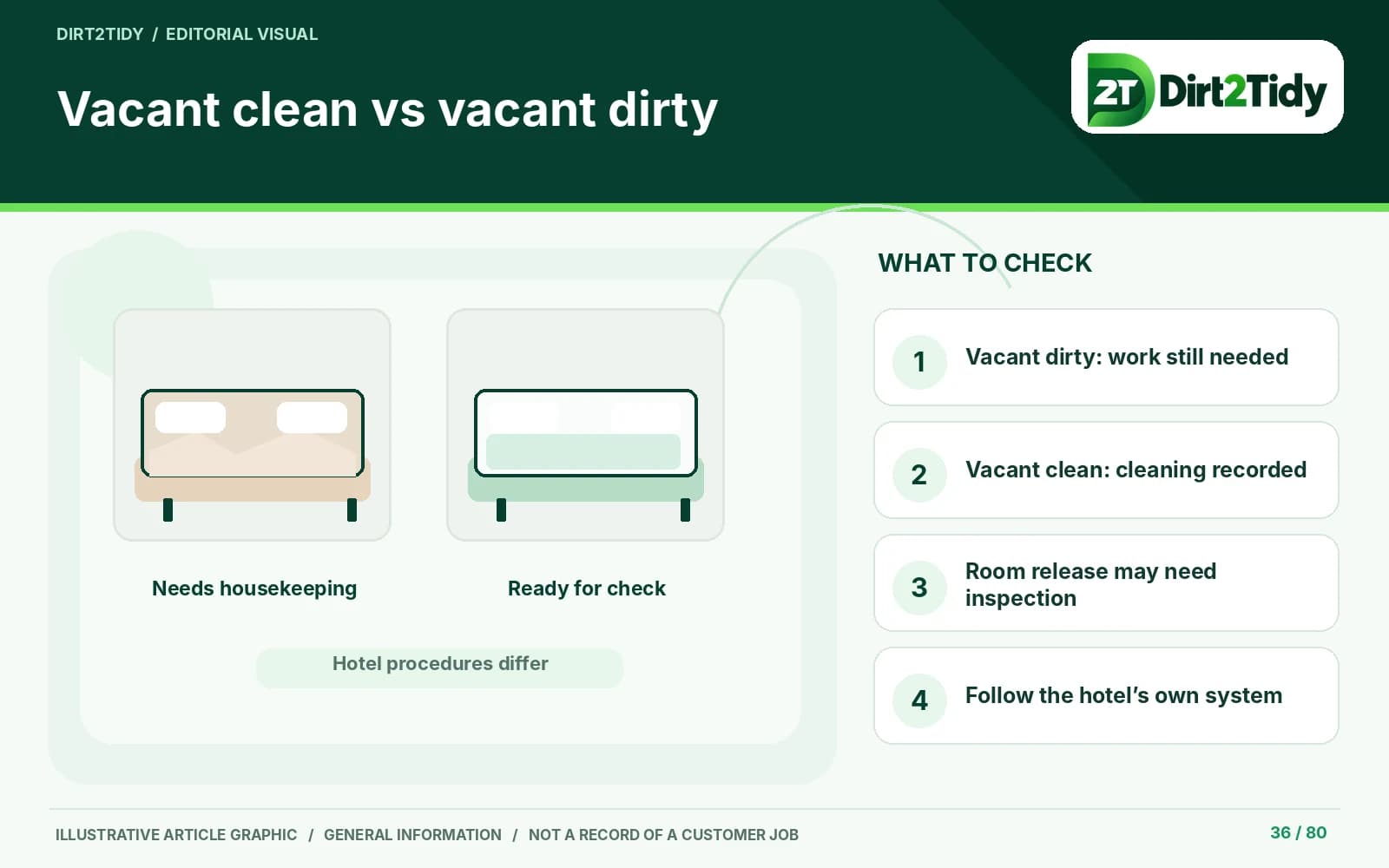
“Vacant Clean” indicates that cleaning has gone through the room after the last visitor has checked out and it is ready for the next stay.
Vacant Dirty” indicates that the previous guest has checked out but the room has not yet been serviced by housekeeping. The change in room status happens in a certain order and may be thought of as the “life cycle” of a guest room. The “readiness” of a guest room for fresh occupancy determines its classification.
As a result, a hotel must be aware of its present occupancy and hygiene at all times. When determining the state of occupancy and the state of both occupancy and cleanliness information for a room. What is a Vacant Cleaning Service?
A vacant cleaning service is a specialized housekeeping process designed for rooms or properties that have recently become unoccupied. After a guest checks out or a tenant leaves, the property may require more than just a quick tidy.
Vacant cleaning ensures that every area is thoroughly cleaned, making the space presentable and ready for inspection, sale, or the next occupant.
This comprehensive service typically includes: Removing leftover belongings and rubbish Sweeping, mopping, and vacuuming all floors Dusting and wiping down all surfaces, including furniture, windowsills, and fixtures Deep cleaning kitchens, including appliances, countertops, and cupboards Sanitizing bathrooms scrubbing toilets, sinks, showers, and tubs Addressing overlooked areas like behind doors, under beds, and inside closets The goal is to return the property to a “vacant clean” status, reflecting high standards of hygiene and presentation.
This is especially important for hotels, real estate managers, or landlords aiming to attract new guests or tenants quickly without delay. A well-executed vacant cleaning service helps prevent missed opportunities for bookings or sales. It also reassures newcomers that the property has been maintained and cared for, setting the stage for a positive first impression.
The process of ensuring that rooms are appropriately labeled by their existing status and assigning a new status when it changes is known as room status reconciliation. Room status is maintained by both cleaning and the front desk.
Each works together to ensure that rooms are allocated, cleaned, and assigned again in order to optimize room income while preventing missed assignments. Vacant / Inspected (V/I) property for sale.
When a vacant ready room is examined by the housekeeping supervisor or executive housekeeper, the room status is changed to “V/I.” This status is typically utilized in full-service or five-star hotel operations. Vacant / Ready (V/R) property for sale. A “V/ R” room status is the only one that may be sold.
Hotels typically use standardized codes to quickly communicate room conditions. These codes form part of the “life cycle” of a guest room. The room is unavailable due to maintenance, repairs, or refurbishment. Not part of the active inventory. This term indicates that the guest is presently staying in the room.
Housekeeping has already attended to the room and performed the necessary cleaning and servicing for the day, ensuring that it remains tidy and comfortable for the guest during their stay.
O/D – Occupied Dirty / Occupied Disturbed This indicates that the room is currently occupied by a guest but has not yet been cleaned for the day. In some cases, the guest may have placed a “Do Not Disturb” sign, preventing housekeeping from servicing the room, which is why the term “disturbed” is also used.
This indicates that the room is currently unoccupied following a guest checkout, but housekeeping has not yet cleaned it. These rooms are considered the highest priority for housekeeping, as they must be serviced promptly to make them available for new guests. The room has been cleaned but not yet inspected. Awaiting supervisor check.
Vacant Possession vs. Move-In Condition In real estate, “vacant possession” and “move-in condition” are often used, but they mean different things.